
The Right Thermostat Setting for an Empty Florida Home
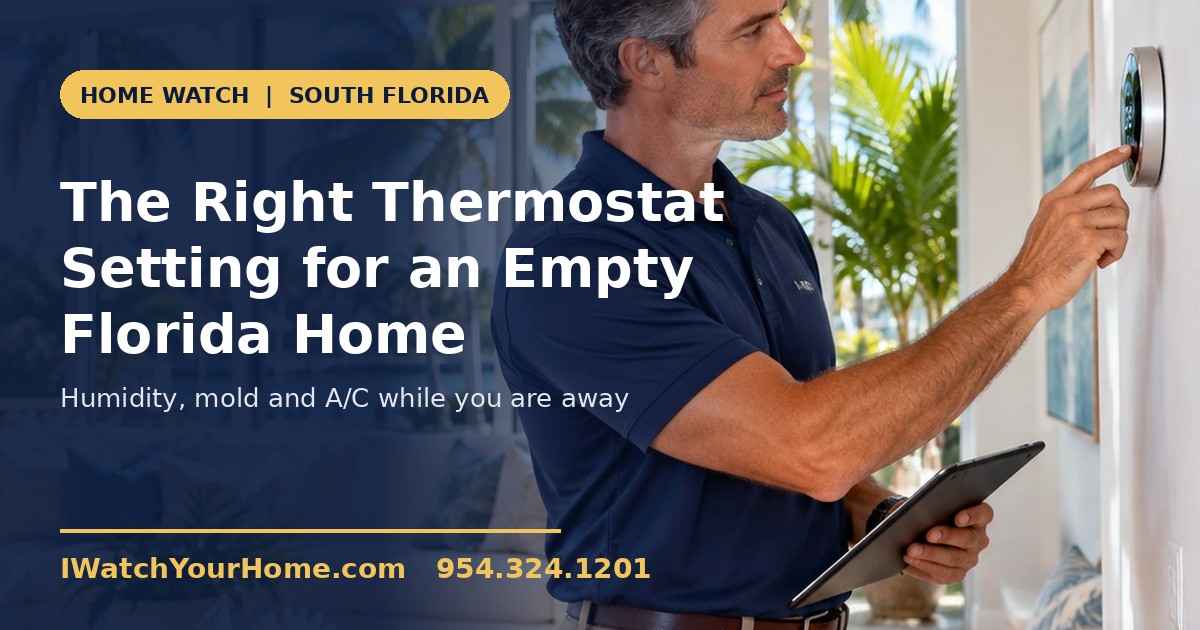
Before snowbirds head north, one question comes up more than any other: “What should I set my thermostat to while I’m gone?” It sounds like a small decision. In South Florida, it is one of the most important choices you will make for your home all year.
Set it too warm, or turn the A/C off to save money, and humidity builds inside a closed house. Mold follows. Set it too cold, and you pay for cooling nobody needs while the system works harder than it should. And no matter what number you pick, the setting only protects your home if the air conditioner is actually running and doing its job.
At I Watch Your Home, a local, family owned home watch company serving Hollywood to Wellington, checking the thermostat and the A/C is part of every visit. This guide explains how we think about thermostat settings and humidity for an empty Florida home, and what can go wrong when nobody is checking.
Why Your A/C Matters Most When Nobody Is Home
Up north, an empty house in summer is mostly a question of security. Here, it is a question of air. South Florida’s outdoor humidity is high for much of the year, and that moisture works its way into a closed home through walls, windows, doors, and the tiny gaps every house has.
Your air conditioner is the main thing pulling that moisture back out. As it cools, it removes water from the air and drains it away. When the A/C is set well, running properly, and draining the way it should, your home stays dry. When any one of those things fails, humidity climbs, and mold, mildew, warped wood, and musty furniture are not far behind.
That is why we tell clients that in South Florida, the A/C is not a comfort system when you are away. It is a protection system.
So What Temperature Should You Set?
There is no single perfect number for every home, and anyone who promises one is oversimplifying. Your home’s size, insulation, shade, windows, A/C system, and whether you have a dehumidifier all make a difference. That said, here is the general approach many South Florida home watch professionals and A/C technicians recommend.
- Keep the A/C on, always. Turning it off entirely to save money is one of the most common and costly mistakes we see. The savings on your electric bill can disappear quickly against the cost of mold remediation.
- Choose a setting in the upper 70s to low 80s. Many owners land somewhere in that range. It keeps the system cycling often enough to pull moisture out of the air without cooling an empty house as if someone lived there.
- Watch humidity, not just temperature. Temperature is only part of the picture. What really matters is how much moisture is in the air, which we cover next.
- Ask your A/C technician. Your system and home are unique. A quick conversation during a service visit, before you leave, is the best way to confirm the right setting for your house.
Humidity: The Number That Actually Protects Your Home
Mold does not care what your thermostat says. It cares about moisture. The EPA’s guidance on mold and moisture recommends keeping indoor relative humidity below 60 percent, and ideally lower. In an empty Florida home, staying in that range is the real goal behind your thermostat setting.
Here is the tricky part. If the thermostat is set high and the house stays fairly cool on its own, the A/C may run so rarely that it never has a chance to remove enough moisture. The temperature looks fine, but the humidity keeps rising. That is how homeowners come back to a house that feels cool and still smells musty.
There are a few ways to manage this:
- A thermostat with humidity control. Many modern thermostats can read humidity and run the A/C to dehumidify, not just to cool. If yours has this feature, ask your technician to set it up for the months you are away.
- A whole home dehumidifier. For larger homes, homes near the water, or homes with a history of humidity problems, a dehumidifier connected to the A/C system can be a smart investment.
- A simple humidity monitor. Even an inexpensive digital hygrometer gives your home watch provider a quick reading on every visit, so a slow climb is noticed early.
Smart Thermostats Help, But They Do Not Replace a Visit
Smart thermostats are great tools. You can check your home’s temperature from your phone, get alerts, and change settings from anywhere. We recommend them to many clients. The U.S. Department of Energy’s thermostat guide is a helpful overview if you are considering one.
But a smart thermostat reports what it measures at the spot on the wall where it hangs. It cannot tell you:
- That the A/C is running constantly but blowing warm air because of a refrigerant problem or a failing part
- That the condensate line is clogged and water is backing up in the air handler closet
- That a back bedroom or closet with poor airflow is much more humid than the hallway
- That the WiFi went down after a storm, so the “normal” reading on your app is hours or days old
- That there is a musty smell in the guest bath that no sensor was placed to catch
A smart thermostat tells you what the thermostat sees. A home watch visit tells you what the house is actually doing.
What We Check on Every Visit
When our team visits your home in Boca Raton, Delray Beach, Pompano Beach, or anywhere else we serve, the A/C and air quality checks are some of the first things we do.
The First Breath Inside
The moment we open the door tells us a lot. A cool, dry, neutral smelling home is a good sign. Warm, heavy, or musty air is not, and it tells us to look closer right away.
Thermostat and System Operation
We confirm that the thermostat is set where you asked, that the system is running, and that the air coming from the vents is actually cool. If you have a humidity reading available, we record it.
The Air Handler and Drain
We look at the air handler area for water in the drain pan, moisture on the floor, or signs of a backed up condensate line. A clogged line is one of the most common A/C problems in our climate and one of the easiest to catch early.
We cover condensate lines and other hidden water sources in detail in How to Catch Water Leaks in an Empty Florida Home.
Closets, Cabinets, and Back Rooms
Humidity problems usually start where air does not move. We check closets, bathroom cabinets, and rooms at the far end of the house for musty smells, spots on walls, or dampness on stored items.
After Power Outages and Storms
Summer and fall storms can knock out power across Broward and Palm Beach counties. When power comes back, some A/C systems restart on their own. Others do not, or a breaker trips and the system stays off. A few days without A/C in September can undo months of careful humidity control. After a storm or outage, we check that your system is back on and running normally.
For a deeper look at the A/C failures we see most in unattended homes, read our earlier article, Top 5 AC Problems That Can Become Major Disasters in an Unattended Home.
Before You Head North: An A/C Checklist
A few steps before you leave can make the whole season easier on your home and your wallet:
- Schedule A/C service before you leave. Ask the technician to clean the coils, clear the condensate line, and confirm there is a working safety float switch.
- Replace the air filter so the system runs efficiently while you are gone.
- Set your thermostat and humidity control based on your technician’s advice, and write the settings down for your home watch provider.
- Open interior doors, closets, and some cabinet doors so air can move through the house.
- Close blinds or curtains on sunny sides of the house to cut down on heat gain.
- Share your A/C company’s contact information with your home watch provider so repairs can be arranged quickly if needed.
For Snowbirds From the Northeast and Canada
Whether you spend the warm months in New York, New Jersey, Connecticut, Massachusetts, Pennsylvania, Ontario, or Quebec, the months you are away from Florida are the hottest and most humid of our year. That is exactly when your A/C works hardest and when a failure does the most damage.
Our Snowbirds Home Watch Services are built around that long summer stretch, with regular visits and photo reports so you can see your home’s condition from wherever you are. For shorter trips, our While I’m Away Home Watch Services cover you on a schedule that fits. Second home owners who visit a few times a year often choose our Vacation Home Watch Services.
If your A/C does need service while you are gone, our VIP Concierge Home Watch Services can let the technician in, stay while they work, and lock up afterward. We can also adjust the thermostat to a comfortable setting a day or two before you return, so you walk into a cool, fresh home instead of a stuffy one.
Where We Serve
I Watch Your Home is based in Coral Springs and serves homeowners across Broward and Palm Beach counties, including Hollywood, Fort Lauderdale, Lauderdale By the Sea, Wilton Manors, Oakland Park, Pompano Beach, Lighthouse Point, Deerfield Beach, Boca Raton, Highland Beach, Delray Beach, Boynton Beach, and Wellington.
We are accredited by the National Home Watch Association, and as a family owned company, we take pride in doing the small things right, visit after visit.
Frequently Asked Questions
What temperature should I leave my Florida home at while I am away?
Many owners choose a setting in the upper 70s to low 80s and keep the A/C on at all times. The right setting depends on your home and system, so confirm it with your A/C technician before you leave.
Should I turn off my A/C when I leave Florida for the summer?
No. Turning the A/C off lets humidity build inside a closed home, which can lead to mold, mildew, and damage to furniture and finishes. Keeping it running at a moderate setting is the safer choice.
What humidity level should an empty Florida home have?
The EPA recommends keeping indoor relative humidity below 60 percent, and ideally lower. A thermostat with humidity control, a dehumidifier, or a simple humidity monitor can help you stay in that range.
Is a smart thermostat enough to protect my home?
A smart thermostat is a helpful tool, but it only reports what it measures at one spot. It cannot see a clogged drain line, a musty closet, or an A/C that is running but not cooling. Regular home watch visits fill that gap.
What happens if my A/C stops working while I am away?
If we find a problem during a visit, we contact you right away with photos and help arrange a trusted local A/C technician. With concierge service, we can let them in and stay until the work is done.
Keep Your Home Cool, Dry, and Checked
The right thermostat setting is a smart start. Knowing it is still working in July, August, and September is what really protects your home. Let us be the ones who check.
Call 954.324.1201 or request your free home watch proposal. Visits start at $69.
I Watch Your Home is a local, family owned, NHWA accredited home watch and concierge company based in Coral Springs, serving homeowners from Hollywood to Wellington.